

No. You don't have to open a separate business bank account as a UK sole trader, and no law forces your hand. Business that sole traders and ordinary partnerships fall outside the rules that apply to limited companies. But most sole traders find that mixing business and personal money makes their tax return a nightmare, and a separate account fixes that instantly.
Here's the practical shortlist most sole traders reach for:
- Keep one dedicated account for anything to do with your trade, even if it's just a basic current account.
- Check the bank's terms if you plan to use a personal account, because some prohibit business use outright.
- Pair whichever account you choose with an accounting tool like SoleDigital to keep your records HMRC-ready without extra admin.
You're not breaking any rules by using your personal account. You're just making your own life harder come tax season.
Key Takeaways
Separating business and personal finances isn't a legal requirement for UK sole traders, but it's the single change that most simplifies tax reporting and bookkeeping.
| Point | Details |
|---|---|
| No legal requirement | Sole traders can legally use a personal account, unlike limited companies which must separate finances. |
| Prepare documents early | Have your UTR, ID, proof of address and two invoices ready before applying. |
| Watch account terms | Personal accounts can be closed if terms prohibit business use, so check first. |
| Compare fees and tools | Weigh monthly fees, transfer charges and invoicing features before choosing a provider. |
| Automate the bookkeeping | Soledigital pairs with any UK business account to turn transactions into HMRC-ready reports automatically. |
Table of Contents
- Who actually needs a business bank account for sole traders?
- How to open a business bank account: eligibility, documents and timeline
- What to compare before choosing a sole trader business account
- Keeping business and personal money separate day to day
- Pair your business account with automated bookkeeping
- Sources
Who actually needs a business bank account for sole traders?
The legal picture is simple: limited companies are legally distinct from their owners, so NatWest points out that company law requires them to keep business money separate. As a sole trader, you and your business are the same legal entity, which is exactly why the rulebook leaves you alone.
That said, several situations tip the balance firmly in favour of opening one:
- You've registered for VAT. Once VAT is in the mix, tracking input and output tax through a personal account gets messy fast.
- Your turnover is climbing. More transactions mean more scope for confusion, and more reason to want clean statements.
- You want access to business credit. Overdrafts, business credit cards, and loans almost always sit behind a business account.
- Clients are asking to pay a business, not a person. Some corporate clients simply won't send invoices to a personal account name.
- You want to look established. A business account name on an invoice reads differently to a personal one, particularly with bigger clients.
There's a risk worth flagging too: personal account terms and conditions often explicitly forbid business use. Banks can, and sometimes do, close accounts that breach those terms, which is the last thing you want mid contract. If you're using a personal account for trading income, it's worth reading the small print rather than assuming nobody's watching.
How to open a business bank account: eligibility, documents and timeline
Opening one is far less painful than people expect, provided you turn up prepared. Eligibility is straightforward: you generally need to be 18 or older, a UK resident, and actively trading as a sole trader.
Here's what to have ready before you start an application:
- Photo ID — a passport or driving licence covers most banks.
- Proof of address — a recent utility bill or bank statement, usually within the last three months.
- Your Unique Taxpayer Reference (UTR) number — HMRC issues this when you register as self-employed.
- Evidence of trading — a couple of invoices, a contract, or your business description and SIC code.
- VAT number, if you're registered.
Banks call the background process behind this Know Your Business (KYB) checking, and it goes further than just confirming who you are. Santander's onboarding guidance lists anticipated turnover, business description, and evidence of trading among the standard requests, and other providers such as Virgin Money publish near-identical checklists.
Most sole traders now open accounts entirely through an app or online form. Lloyds Bank's guidance describes activation happening within days for straightforward applications, though banks sometimes follow up for extra documents if something doesn't quite match, which can add a few more days to the wait.
Pro Tip: Have your UTR and two recent invoices saved as PDFs before you start the application. Missing proof of trading is the single biggest reason sole traders get stuck in a follow-up verification loop.
What to compare before choosing a sole trader business account
Fees and features vary more than people assume, and the wrong choice can cost you time as much as money. Before you commit, weigh up:
- Monthly fees and transaction charges — some accounts are free until you hit a transaction limit, others charge from day one.
- Charges for cash deposits and CHAPS or BACS transfers — these add up quickly if you handle physical cash regularly.
- Invoicing tools and statement exports — HSBC and other major banks now build invoicing features and clean statement formats into business accounts, which makes feeding data into accounting software far less fiddly.
- App quality and card acceptance — a clunky app makes daily reconciliation a chore rather than a two-minute job.
- Direct Debit and standing order support — essential if you pay suppliers or subscriptions on a schedule.
- Credit facilities — banks will often run a credit check even for a basic sole trader account, and if you want an overdraft, expect closer scrutiny of your personal credit history.
- Switching support — check whether the Current Account Switch Service (CASS) covers the account, which automates moving payments and Direct Debits across.
Money notes that business accounts building a credit footprint for your trade is a genuine, if underrated, benefit. If you ever want a business loan later, that history matters.
Keeping business and personal money separate day to day
The routine matters more than the account itself. A business account only helps if you actually use it consistently, and that means a few small habits done weekly rather than a big cleanup once a year.
- Use a dedicated business debit card for every purchase related to your trade, no exceptions.
- Pay yourself in deliberate drawings rather than dipping into the account whenever cash is tight.
- Set aside ten minutes a week to tag transactions, rather than letting three months pile up.
- Turn on bank feeds where available, so transactions flow into your records automatically instead of manual entry.
This is exactly where SoleDigital earns its keep. It reads job descriptions in plain English, captures receipts automatically, and turns your bank activity into invoices and HMRC-ready reports without you touching a spreadsheet.
Pro Tip: Reconcile weekly, not monthly. Five minutes every Friday beats a two-hour scramble the night before your tax return is due.
Typical onboarding frictions and pragmatic mitigations
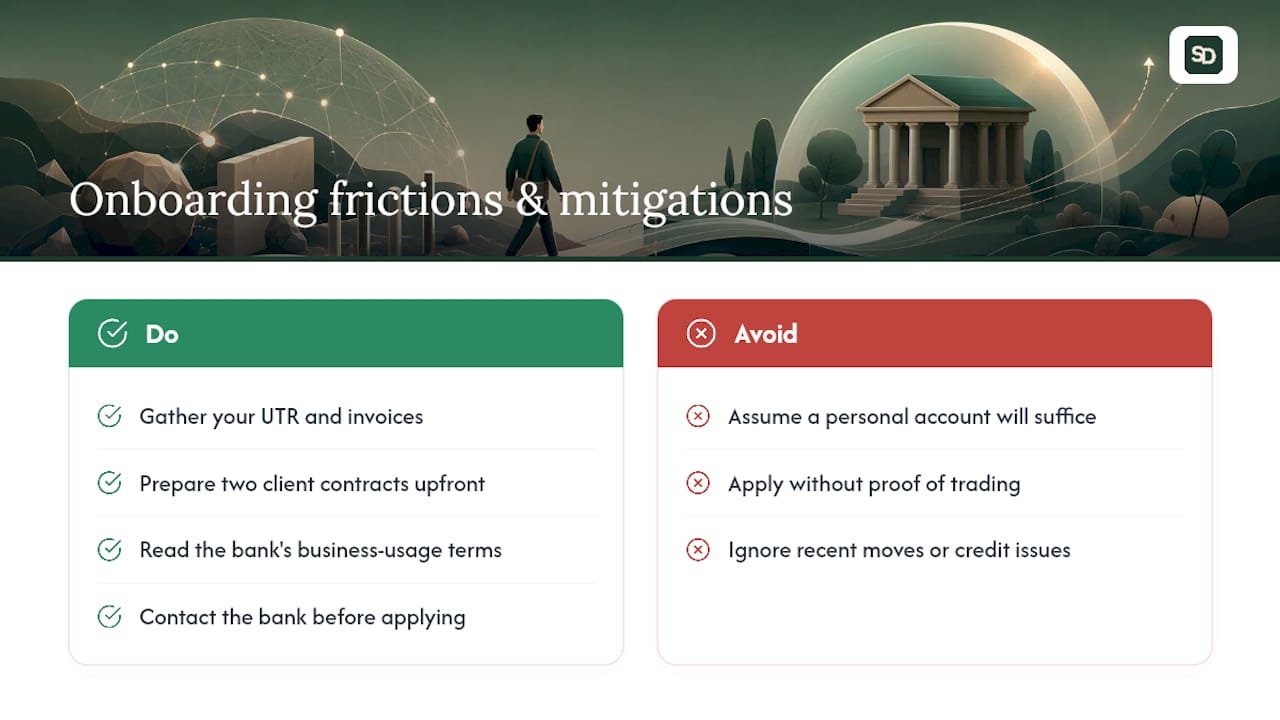
The most common stumbling block isn't identity checks, it's proof of trading. New sole traders without invoices yet often get stuck in follow-up requests that could have been avoided with two client contracts ready upfront. Long address histories and unexpected credit checks trip people up too, especially those who've moved house recently or carry existing debt.
Before applying, gather your UTR and a couple of invoices, and actually read the bank's terms on business usage rather than assuming a personal account will quietly do the job. If your tax status is unusual or your credit history is patchy, it's worth speaking to the bank directly before you apply rather than after a rejection.
— Bobby
Pair your business account with automated bookkeeping
Once your account is open, the real win comes from what happens with the data it generates. Soledigital is built specifically for UK sole traders who want their bank activity turned into proper records without spending evenings on spreadsheets.
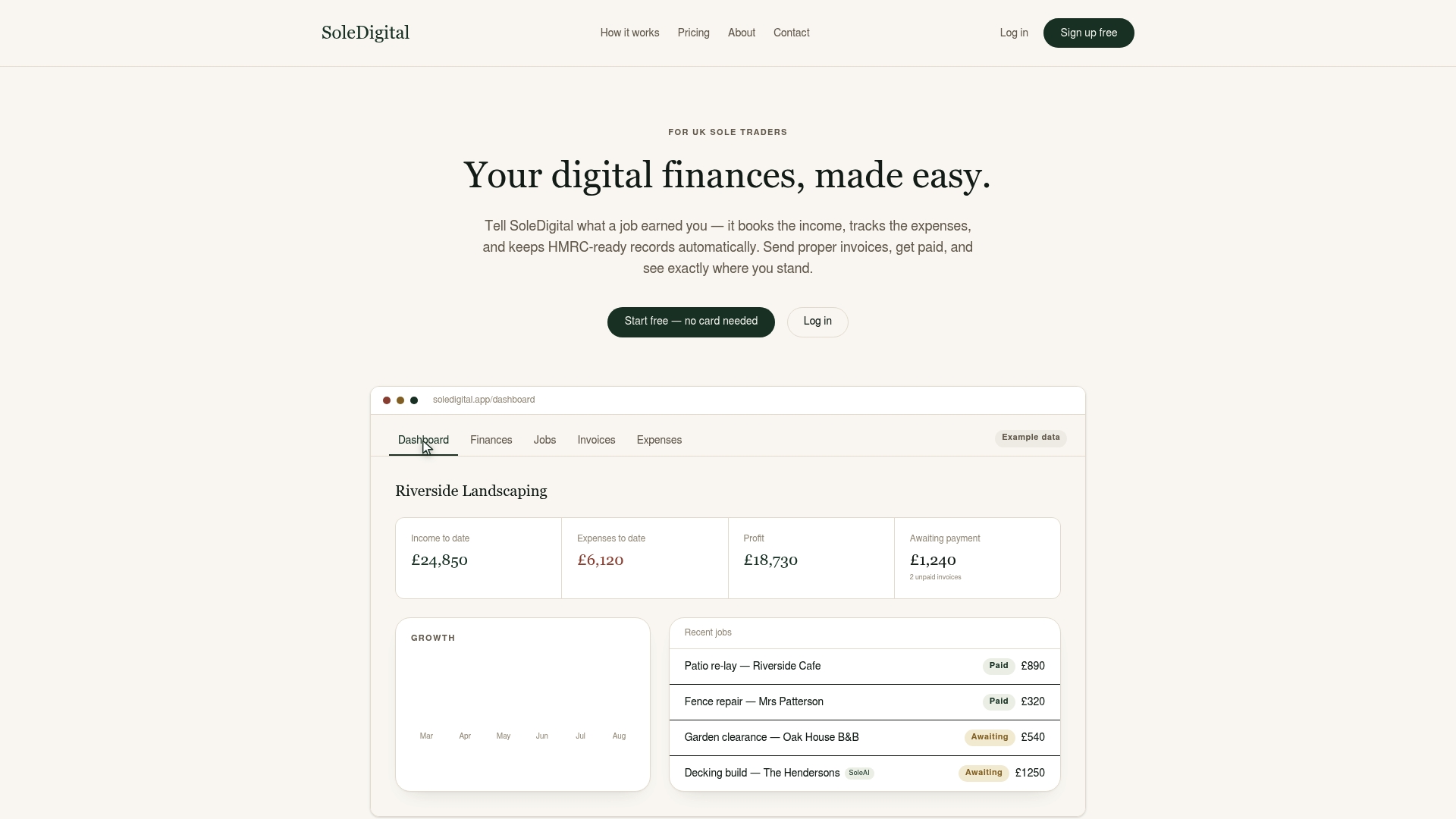
Tell it what you did for work in plain English, and Soledigital's AI assistant, SoleAI, turns that into a categorised transaction, a matched invoice, or an answer to a tricky HMRC question, all without you needing an accounting background. Receipts get read automatically, jobs get logged in seconds, and your reports stay ready for HMRC whenever you need them, whether that's at tax return time or when a client asks for a statement. It's the layer that makes a business account actually useful rather than just another login to check.
If you're ready to stop reconciling manually, try Soledigital or view pricing plans to see which tier fits how you work.
Sources
- Business
- Opening a Business Banking Current Account | Santander UK
- Do I need a business bank account? | NatWest Business
- Money